

Where the Fire Leaves Its Scars
What the kitchen gave me, what it took, and the ember that still burns.
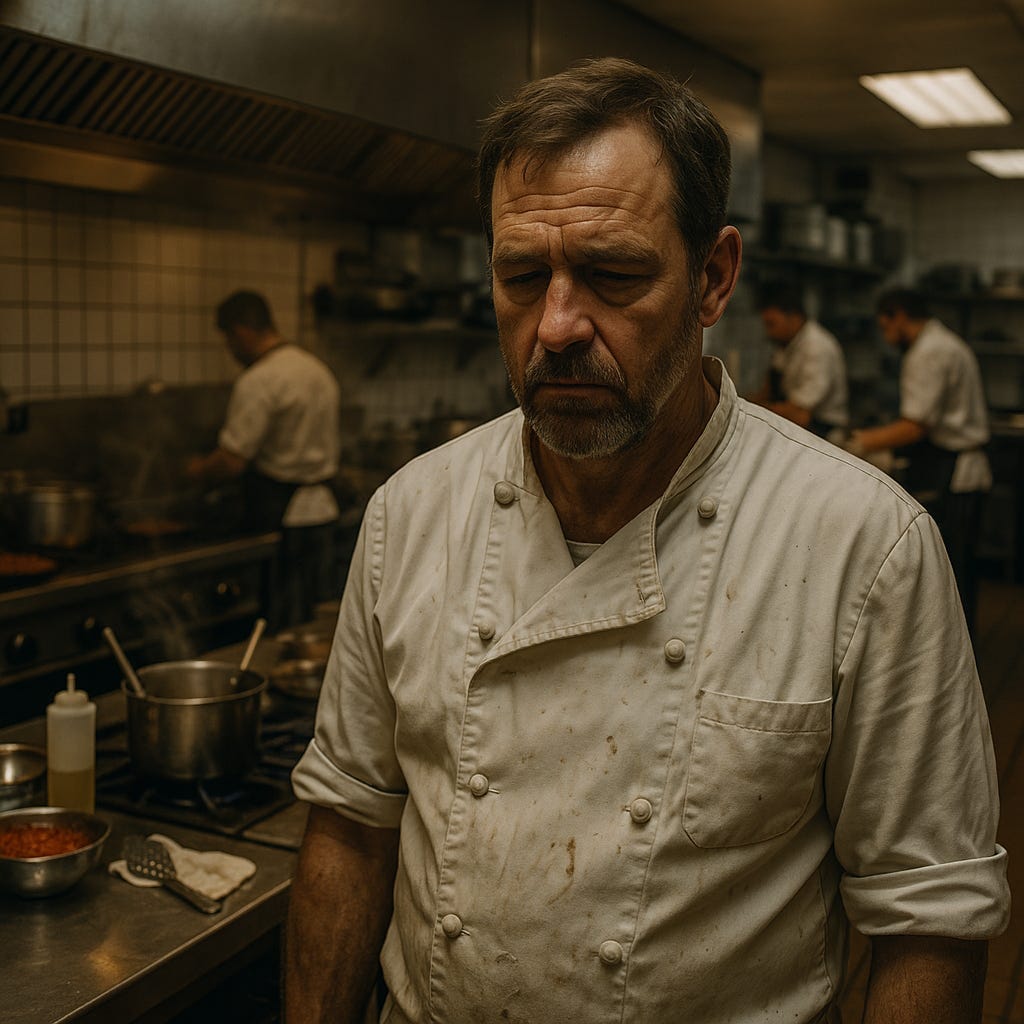
Author’s note:
CMT 2A is a form of Charcot-Marie-Tooth disease, a progressive neuropathy that weakens the nerves in my legs and hands. I was diagnosed as a kid. Forty years later, I’m still here—still cooking, still writing, still tending the fire.
By: Ken Lewis
Some nights after service, I’d sit alone in the car. Engine off.
Hands trembling so bad I couldn’t light a cigarette.
They still smelled faintly of garlic and steel—the scent of a day’s work baked into my skin no matter how hard I scrubbed.
I’d stare at my reflection in the rearview mirror—eyes hollow, skin sallow from weeks of ninety-hour shifts—and whisper:
“What the fuck are you doing?”
But I’d be back the next morning.
Because this was the life I chose.
Or maybe it chose me.
Running a catering operation isn’t glamorous.
It’s not Food Network shit—no white coats, no plated perfection, no soothing piano over B-roll.
It’s war. Period.
“There’s no crying in the kitchen. You figure it out or you die trying.”
It’s waking in the dark with prep lists screaming in your skull.
Threading the impossible needle of food orders—not too much, not too little—or you blow your margins wide open.
It’s sweating over labor costs that creep like a slow cancer.
Running numbers in your head at 2 a.m. because you’re bleeding money and there’s no room for error.
It’s hot boxes failing. Trucks that won’t start. Propane lines hissing like a threat.
It’s the sinking dread of realizing half your staff isn’t coming in.
Sick. Hungover. Or just didn’t call at all.
You grit your teeth. Tighten the roster. Push forward.
And my crew?
Jesus Christ, my crew.
A feral family of glorious, dysfunctional maniacs.
Artists. Drifters. Kitchen lifers who couldn’t hack it in the “real” world but somehow thrived in this one.
“They were brilliant. They were a nightmare. They were mine.”
The line cook with track marks under his chef coat sleeves who still made the best pan sauce I’ve ever tasted.
The server who’d sneak out for a cigarette, sobbing over a breakup, then come back smiling and carrying trays like nothing happened.
The dishwasher barefoot again because he swore he “worked better without them.”
We fought like family. We loved like family.
Half of them had no business in a professional kitchen, but I couldn’t have done it without them.
I miss them.
God, I miss them.
But here’s the truth I didn’t want to face back then:
I was breaking too.
CMT 2A didn’t crash down all at once.
It seeped in like rot.
First my hands betrayed me—the fine knife work turning clumsy when the tremors came bad.
Then my legs—lead-heavy after doubles, ankles swelling until every step felt like punishment.
One year I could haul full cambros up stairs without thinking.
The next, I gripped the railing so tight my knuckles whitened.
“I lied. I covered. I pushed harder. But in the quiet—adrenaline gone, lights off—I knew: I wasn’t fine.”
Some nights I stood alone in the dark kitchen after the last dish pit hose hissed its final breath, staring at my reflection in the pass window.
Drawn face. Hollow eyes. A stranger staring back.
I’d press a trembling hand to the stainless steel, cold against my skin, and wonder how much more I could give before I burned all the way down.
The kitchen gives. The kitchen takes.
It gave me twenty-five years of purpose and pride.
Scars I wear like tattoos.
A voice that doesn’t waver even when everything else falls apart.
“Leadership isn’t barking orders—it’s bleeding beside your crew and holding the line.”
Chaos isn’t the enemy; it’s the forge.
Love in a kitchen isn’t flowers or words; it’s a server slipping you family meal at midnight because they know you haven’t eaten since breakfast.
But it took too.
It took my youth. My body. My belief I could always “push through.”
I’ve cried in the walk-in, fists clenched until knuckles ached.
Screamed into my steering wheel until my throat burned.
Collapsed on the kitchen floor still in my clogs—too tired to shower, too wired to sleep.
“No one tells you how much of yourself the fire burns away.”
Hanging up my chef coat wasn’t noble.
It was survival.
But the fire doesn’t leave.
Now I tend the smoker at dawn, cold air biting my cheeks as hickory curls into fog.
I write in the half-light, fingers stiff but willing.
I cook for my family in a kitchen quiet enough to hear my own thoughts for the first time in decades.
The pace is slower. The stakes are different.
But the ember’s still there.
The world wants to tame you.
Make you soft-edged. Agreeable. Predictable.
Tired enough to stop reaching.
But you’ve stood in the heat.
Carried the weight.
You know what it costs to hold the line.
“You don’t walk away from fire without marks.”
Not as long as there’s still a spark in your chest.
Not as long as you can feel the ghost of your chef coat clinging to your back, even now.
So stoke the coals. Write the words. Love like your ribs aren’t armor.
And when the wildness stirs—don’t silence it.
This is where the fire leaves its scars.
Speechless! Great words. Thank you!!
Wow! Thank you so much.