

Orchard Hands
A grandson, an orchard, and the hard truth his grandfather taught him about cutting away what no longer serves.

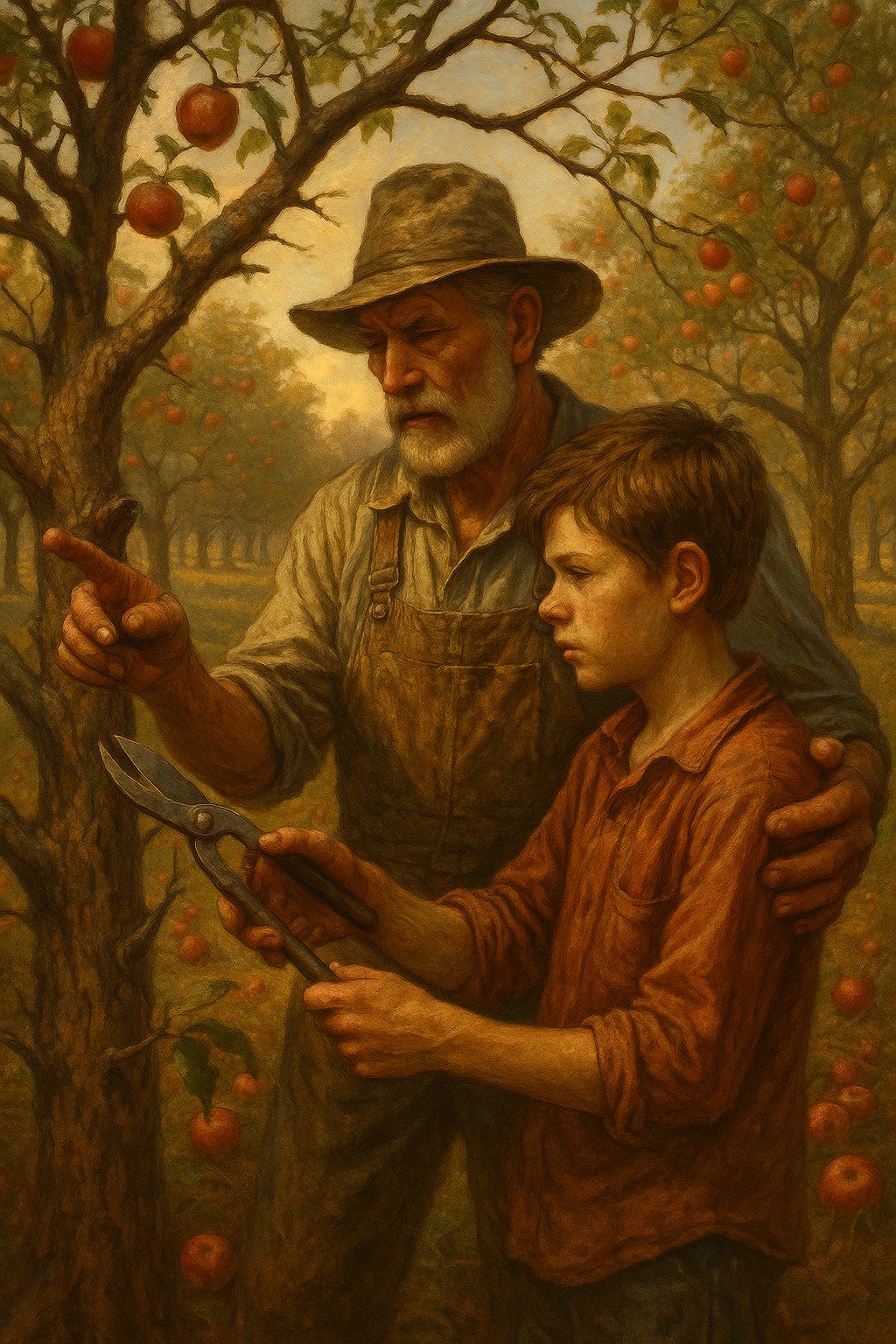
By Ken Lewis
The orchard taught me more about living than any preacher or poet ever could. It was pain and patience, sweat and steel, and the quiet truth that growth will cost you something.
I was eight or nine the first summer he put a pair of clippers in my hand.
The orchard wasn’t much to look at by then. Rows of tired apple trees, branches gnarled like the hands that pruned them, dirt cracked and dry from too many Augusts without enough rain. But to him, it was sacred ground.
“Keep your cuts clean,” he said. “A sloppy cut kills a limb.”
His voice was low, gravelly. He never raised it, but you listened anyway. There was a weight to his words—the kind you don’t question.
That summer became a kind of baptism. Sweat stinging my eyes, fingers blistered raw, the sun baking the back of my neck until the skin peeled. We worked from first light to when the air turned cool and the dust smelled sweet again.
He never called it a lesson, but it was. Every branch he handed me was an invitation: to pay attention, to slow down, to understand that life and death could hinge on the angle of a blade.
I learned quickly: pruning wasn’t about removing what was dead—it was about making hard choices for what might live.
“Sometimes you’ve got to cut back the parts that are still green,” he said once, wiping sap from his thumb with an oil-stained rag. “If you don’t, the whole tree suffers.”
I didn’t get it then. Not really. I thought it was just about apples—more fruit, bigger yields, keeping the orchard alive another year.
But years later, standing in a kitchen at midnight, hands shaking from too many bad choices, I remembered his words. Not in a soft way, but sharp—like a blade in the dark.
Cut back what’s still green.
I thought about friendships I’d clung to out of habit, jobs I stayed in long after they’d soured, old versions of myself I refused to let die. All the ways I’d let the wrong parts of me grow wild until I couldn’t see the sky anymore.
The orchard taught me something about pain too—the kind of pain that serves a purpose.
You don’t prune a tree gently. You make hard, clean cuts that leave the wood raw and weeping. But come spring, the sap rises, the wounds scar over, and new growth bursts from what looked lifeless.
I watched it happen every season with my grandfather. And later, I watched it happen in myself.
He’s gone now. Buried on a hill where the air still smells like sun-warmed apples in September. The orchard’s mostly gone now too—only a few trees standing, as if they’ve got something to prove.
Sometimes I walk those rows in my head—the ones we cleared together, my small hands clumsy on the clippers, his large ones steady as old roots. I can still hear him:
“Keep your cuts clean.”
It’s a simple rule. But it’s saved me more than once.
I prune without apology now. Regrets, wasted years, people I thought were family—all cut away like rot beneath the bark.
Because a man who’s been in an orchard in late summer knows: growth always costs something. And the tree never misses what it didn’t need.
Beautiful and a great lesson. Thank you for sharing this 🙏