

Tend, Burn, Try Again
What open-fire cooking taught me about hunger, memory, and the heat we keep coming back to.

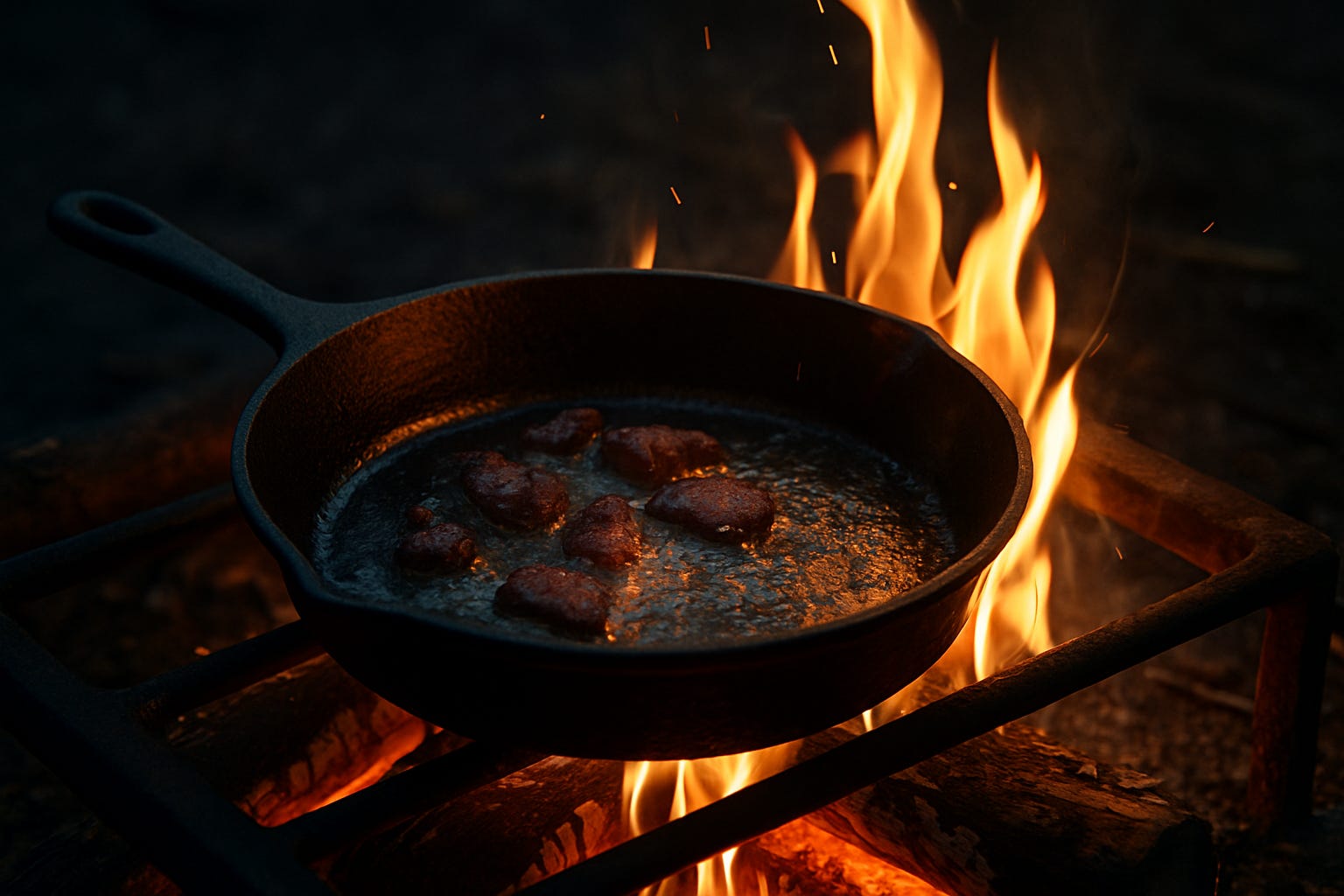
The first time I cooked over an open fire—really cooked, not just tossing hot dogs on a grate or watching someone else babysit the flames—I was maybe ten years old.
My dad handed me a pair of tongs and told me not to be afraid of the heat.
“Fire don’t bite unless you let it,” he said, voice steady as the embers snapped below us.
I remember the way the flames licked at the cast iron, the way fat hit the coals and sent sparks flying like fireflies let loose. That moment lit something in me—a hunger that wouldn’t go out.
Fire does something to food, and to people.
It deepens things. Sharpens them.
Burns away the bullshit until only the real stuff’s left.
It’s the oldest way of cooking—the most honest.
No thermostat. No timer. No safety net.
Just flame and instinct.
You’ve gotta watch it. Listen to it.
Learn how it moves, how it breathes.
It’s wild. Unpredictable.
But if you pay attention—if you respect it—it’ll work with you, not against you.
Summer Is the Season of Fire
Of cooking outside because the kitchen’s a furnace.
Of sweat soaking your shirt while the grill hisses and pops.
Of charred edges, blistered skins, and meat that’s been kissed by flame just enough to taste like something more than itself.
It’s hunger—not just for food, but for something primal. Something real.
This time of year, that craving always hits hard—for fire-seared flesh, for food heavy with woodsmoke, for something that cooks slow while the air hums with crickets and laughter and the low murmur of stories circling a fire.
It’s not about convenience—hell, fire cooking is anything but convenient.
It’s about the ritual. The waiting.
The way a good cut of meat transforms through time, turning from raw and wild to something rich, dark, and impossible to forget.
You feed the fire as much as it feeds you.
Stoke it when it’s dying. Tame it when it flares too high.
It’s a conversation—a back and forth.
A lesson in patience, control, and letting go.
Too many people rush it—slamming steaks onto flames that’re too damn high, burning the outside while the inside stays cold and useless.
But fire, like hunger, can’t be forced.
You’ve gotta let it work slow.
Let it wrap around the food in its own time.
I didn’t know it back then, but standing in that smoke taught me more than any kitchen ever did.
I’ve burned things. Ruined plenty.
But I kept showing up.
Kept feeding the fire.
Somewhere in that rhythm—tend, burn, try again—
I became something else too.
I think about all the fires that came before—
cooking the first meals in these mountains long before grills, cast iron, or recipes.
Hunters gutting their kill and feeding their families with nothing but flame and meat.
Loggers warming stiff hands over smoky fires, roasting whatever they had—just enough to make it through another hard day.
And I think about myself, years later, learning to cook from those same flames—
how to let smoke weave into my food,
how to trust my gut over any damn thermometer.
Because that’s what summer cooking really is.
It’s not delicate. Not fussy.
Not about perfect measurements or digital timers.
It’s feel. It’s smell.
It’s the kind of hunger that builds in your chest while the meat hisses and the smoke clings to your clothes, knowing full well it’s gonna be worth it.
I still cook like that—
out back, smoke in my eyes, hands raw with salt.
Still chasing that same fire.
So we keep feeding the flame.
Keep standing in the heat.
Keep cooking with our hands, our instincts, and that hunger summer always brings.
Because when the flames die down and the food’s gone,
the fire’s still there—
smoldering low,
waiting for the next meal,
the next night,
the next story to be whispered into the smoke.