

The body keeps a ledger
On Pain, Infection, and the Cost of Pretending You’re Fine

I didn’t almost die.
Let’s get that straight.
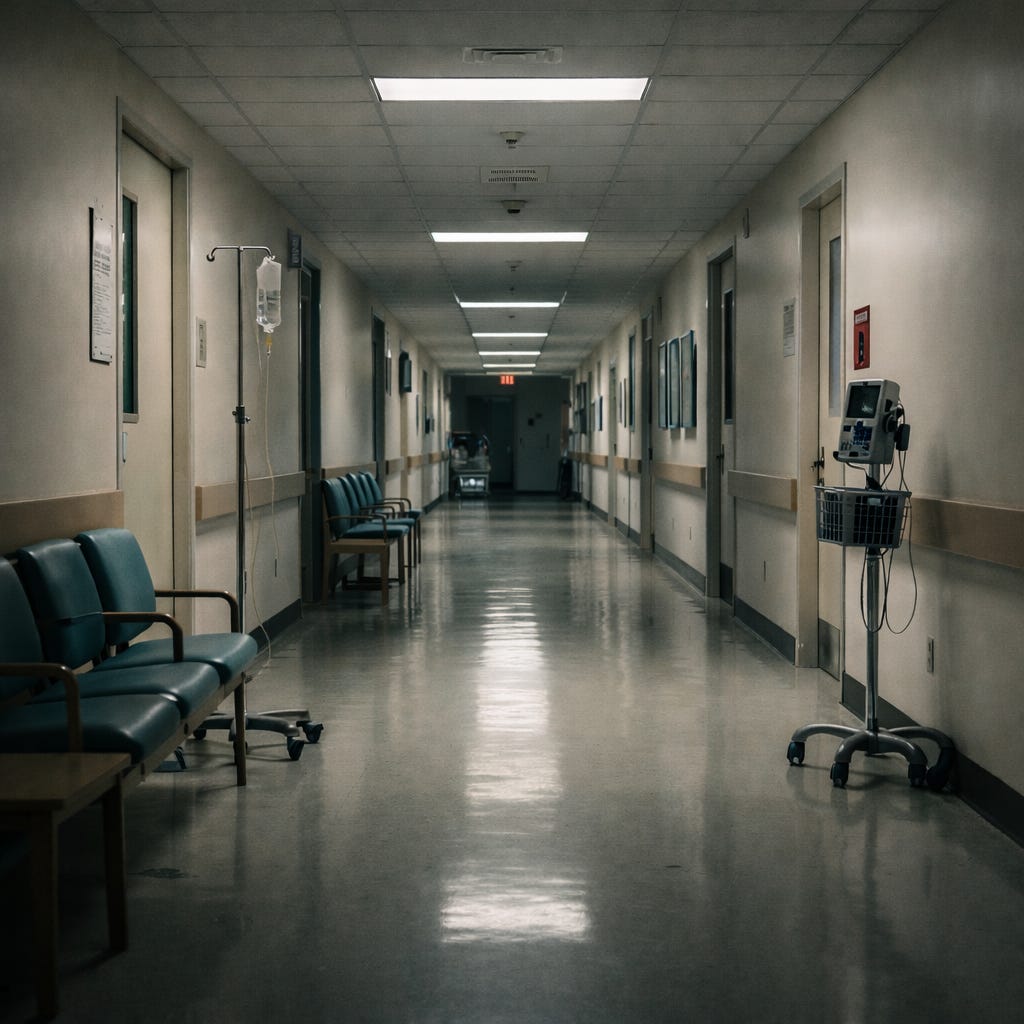
I didn’t see a tunnel or dead relatives waving me home or God tapping his watch. What I saw instead was fluorescent light bouncing off beige walls and a doctor who wouldn’t meet my eyes while explaining how fast things had moved. How something small had decided it wasn’t small anymore.
Cellulitis is a polite word.
It sounds like skincare.
It sounds like a magazine ad.
What it actually is: your body losing jurisdiction over a piece of itself.
One minute it’s soreness.
The next minute it’s heat.
Then swelling.
Then a red line that looks a little too intentional — like your blood is trying to escape.
I’ve spent my life negotiating with pain.
This wasn’t a negotiation.
This was a bill coming due.
They hung antibiotics like church banners and told me to stay still. That’s when it hits you — not the pain, but the math.
How many infections have you shrugged off.
How many warning signs have you treated like inconveniences.
How many times have you trusted grit instead of judgment.
The body keeps a ledger.
It never forgets.
It just waits.
I’ve lived long enough inside a failing system — my nerves misfiring, muscles thinning, joints bargaining for one more year — that I started to believe survival was a personality trait. Like stubbornness or humor. Like I could outwork entropy if I just stayed useful.
That’s the lie men like me grow up with.
Be useful.
Be quiet.
Don’t make it worse.
In the hospital, usefulness evaporates.
You don’t get points for toughness.
Nobody cares how much you’ve endured.
You are a chart.
A vein.
A number on a screen that blinks when something goes sideways.
And here’s the ugly truth I don’t love admitting:
part of me wanted it to be worse.
Not death.
Not drama.
Just something definitive.
Something that would force the question instead of letting me keep dodging it.
Because living on the edge of manageable is exhausting.
The infection didn’t care about my plans.
Or my writing schedule.
Or the things I still want to make.
It didn’t care that I’ve already given up enough.
It just did what bodies do when they’re overwhelmed — it escalated.
That’s what scared me most.
Not the pain.
The speed.
I came home quieter than I left.
Not grateful — quieter.
More aware of the space between fine and fucked.
More aware that the body doesn’t announce thresholds.
It crosses them.
Recovery isn’t cinematic.
It’s boring.
Pills.
Rest.
Watching redness retreat like a bad tide.
Listening to your body not for poetry — but for data.
And somewhere in that dullness, something shifted.
I’m done pretending that endurance equals virtue.l
I’m done confusing suffering with strength.
I’m done waiting for collapse to justify change.
This wasn’t a warning shot from God or fate or the universe.
It was simpler than that.
It was biology reminding me that I am not exempt.
I still want to write.
I still want to make things that last.
I still believe in fire and salt and memory.
But I don’t owe the world my blood to prove it.
If there’s a lesson here — and I hate lessons — it’s this:
Pay attention earlier.
Rest before you’re forced to.
Tell the truth while your body still has the energy to back you up.
I didn’t almost die.
But I got close enough to hear the bill being printed.
And I’m finally ready to stop pretending
I didn’t order half of it.