

The Knife Roll
What twenty-five years in kitchens taught me about steel, labor, and the slow negotiation between a body and the work it still loves.

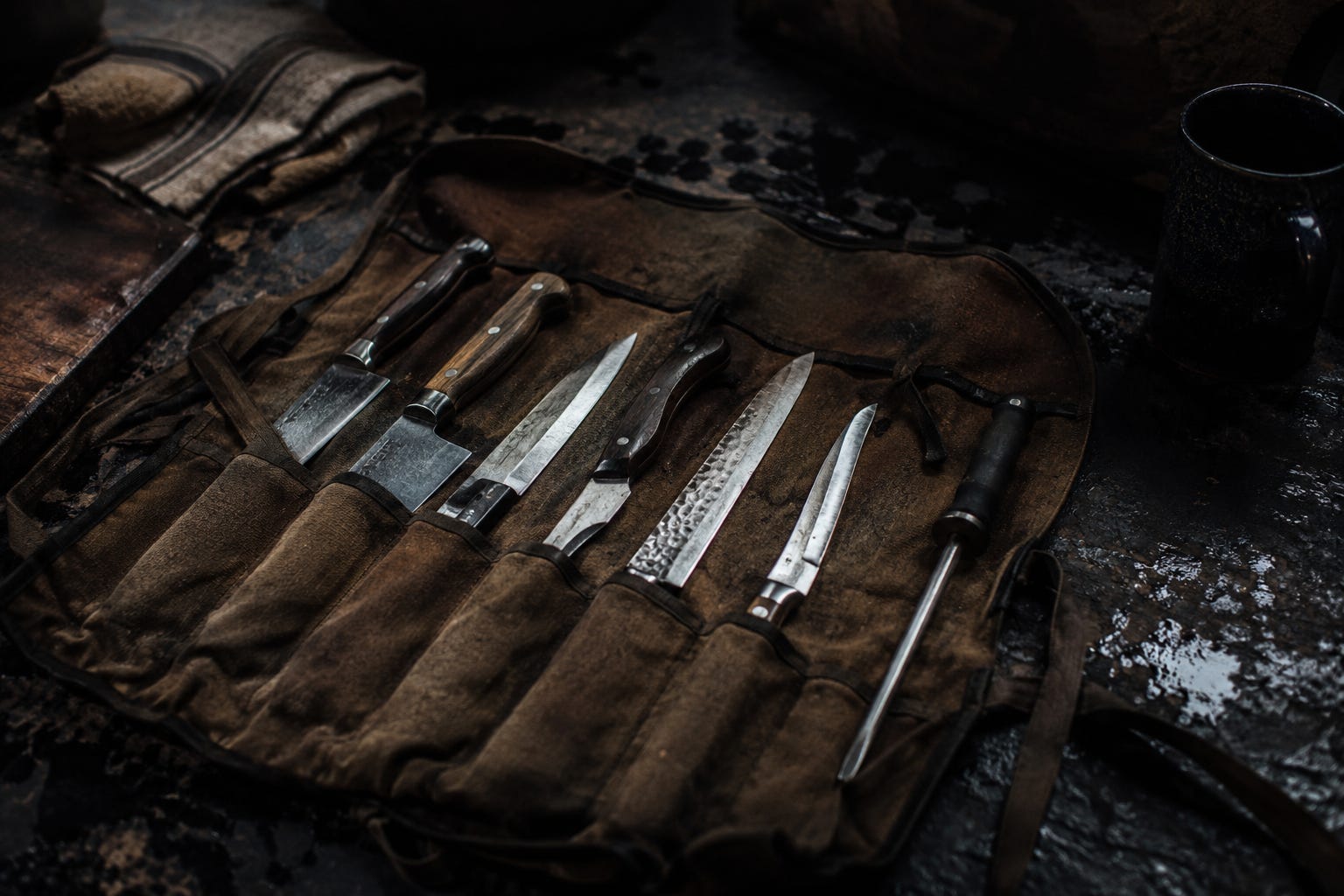
There’s a moment every cook knows.
End of the night. Kitchen finally quiet. Hood vents still humming overhead like tired machinery in a factory after everyone’s gone home. Floor damp from the mop bucket. Hands smelling like onion, steel, smoke, bleach, citrus, animal fat, garlic, and heat. The strange permanent scent of labor.
And then there’s the knife roll.
You untie it slower at night than you do in the morning.
Morning is ambition. Morning is velocity. Morning is the lie that the body will do exactly what you ask of it if you just move hard enough.
Night is inventory.
Night tells the truth.
Every knife goes back into its slot one at a time.
Chef knife.
Boning knife.
Petty.
Serrated.
Honing rod.
Sometimes a peeler rattling around in the bottom because kitchens are never as organized as cooking shows pretend they are.
And every cook I’ve ever known checks the edge with their thumb the same way.
Not enough to cut yourself.
Just enough to know.
Still there.
Still sharp.
Still working.
I used to think knives were about control.
That’s how young cooks think about them.
Precision. Dominance. Speed.
You learn how to move fast enough that people stop questioning whether you belong there. You develop that little unconscious swagger cooks get when they realize they can break down fifty pounds of onions faster than most people can load a dishwasher.
You mistake efficiency for invincibility.
Then the body changes.
Not all at once. That would almost be easier.
Instead it renegotiates with you slowly.
Finger by finger.
Joint by joint.
Balance shifts.
Grip changes.
Muscles burn sooner.
Recovery gets longer.
Things begin costing more than they used to.
The knife doesn’t care.
Steel is honest that way.
A dull knife punishes hesitation.
A sharp knife punishes arrogance.
There’s probably a lesson in that somewhere.
I still keep my knives sharper than most people think is reasonable.
Maybe because they’re one of the few tools left in my life that still reward attention immediately.
Treat them right and they answer truthfully.
Neglect them and they tell on you the second pressure gets applied.
People romanticize kitchen tools now. Whole internet ecosystems built around walnut handles and hand-forged Japanese steel photographed next to linen towels and perfect natural light.
Most real kitchen knives have seen uglier things than that.
Mine have ridden around in milk crates. Fallen behind prep tables. Been sharpened half-asleep before dawn. Been used in kitchens so hot your back stayed damp for twelve straight hours. They’ve cut onions while rent was late. Cut herbs while relationships were ending. Cut brisket while pretending not to limp.
Tools absorb history.
That’s why old cast iron feels different in the hand than new cast iron.
Why your grandfather’s shovel somehow weighs more emotionally than physically.
Why an old knife can feel almost alive after enough years together.
Not magic.
Memory.
I think that’s what cooking really is underneath all the performance and branding and internet nonsense.
Memory transferred physically.
One person leaving proof behind that they were here and tried to care for someone before everything went dark.
That sounds dramatic until you’ve fed people long enough.
Then it sounds obvious.
The older I get, the less interested I am in perfection.
Perfect plating.
Perfect kitchens.
Perfect bodies.
Perfect systems.
Most of that stuff exists to hide fear anyway.
Fear of being ordinary.
Fear of slowing down.
Fear of being seen struggling.
But a knife edge tells the truth immediately.
Either it cuts clean or it doesn’t.
No branding strategy survives contact with a tomato skin.
Maybe that’s why I still love cooking after everything.
Because underneath all the noise, it remains brutally honest work.
Fire too hot will burn the food.
Too little salt and the dish dies.
A neglected blade slips.
A tired body eventually collects its debt.
Reality remains reality in the kitchen no matter how badly people want aesthetics to replace substance.
And honestly?
There’s comfort in that.
Because the world outside increasingly feels like performance layered on performance layered on performance until nobody remembers what was real underneath it.
But steel remembers.
A knife edge does not care about your online persona.
Cast iron does not care about motivational language.
A cutting board does not care about your politics.
The onion still needs cutting either way.
There’s mercy in ordinary labor when the world becomes too abstract.
Tonight I cleaned my knife slowly.
Not because I had anywhere important to be afterward.
Not because someone was watching.
Just because after all these years I’ve started understanding that maintenance is a form of respect.
For tools.
For work.
For bodies.
For whatever years remain.
And maybe that’s adulthood in the end.
Not conquering the world.
Just learning how to care properly for the things that carried you through it.
If this essay meant something to you, subscribe free to Smoke & Pine.
Every Tuesday and Thursday I publish essays on food, labor, wilderness, memory, adaptation, and the strange work of learning how to remain yourself inside a changing body.