

Winter: Fire Kept for Survival
When your body fails—but the work still demands you

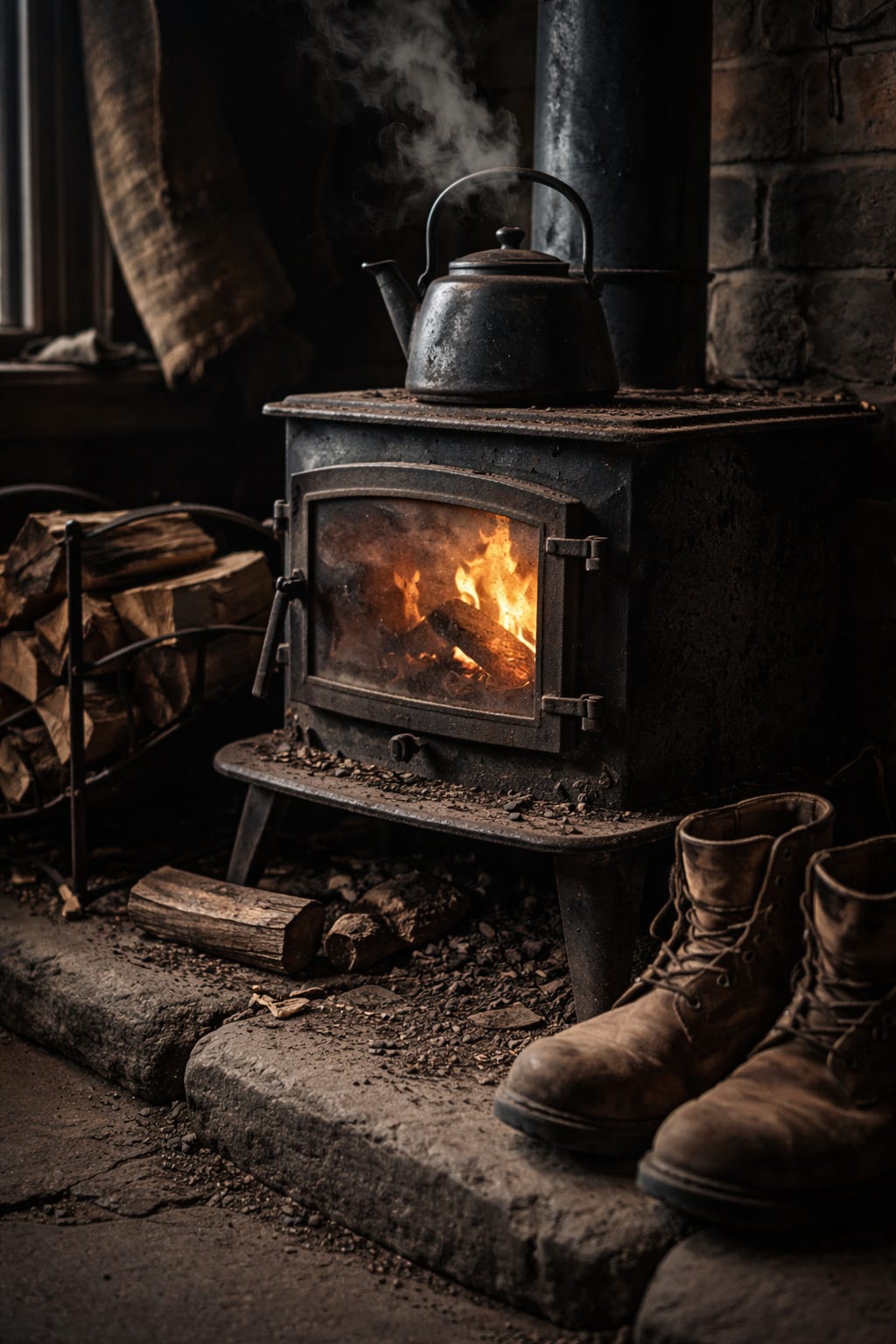
With my kitchen life behind me—not gone, just changed into something I didn’t recognize—I finally had time to face what I’d been avoiding for years: the wreckage CMT had made of my body.
Not just my feet, legs, and hands.
But the rhythm of who I was.
The way I moved.
The way I stood at a stove.
The way I made sense of the world through my hands.
The doctors had warned me—neurologists, orthopedists—always in that sterile, over-sympathetic tone, like they were scared to say it too loud.
Surgery was inevitable, they said.
If I wanted to keep walking, I’d have to be rebuilt.
And then eventually turned into as soon as possible.
In late 2021, my right foot gave out completely.
Twisted.
Deformed.
Barely functional.
There wasn’t a decision left to make.
Just survival.
That first surgery was brutal. Six and a half hours. They fused bones, stretched tight tendons, inserted plates and screws, drove a metal rod from heel to mid-calf, and amputated part of my fibula.
I came out of it a patchwork of steel, stitches, swelling, and stubbornness.
Scarred up.
Held together by sheer fucking grit.
But a year later, that rod failed.
Just like that.
Back to square one.
They cut me open again—this time running a longer rod all the way from heel to knee. More trauma. More recovery. And just when I thought I was through the worst of it, I tore a ligament in my knee during rehab.
Same leg.
Third surgery.
Another scar.
Another stretch of time staring at the ceiling, wondering how much more I could lose and still be me.
Each surgery knocked me down for months.
The first came just as the leaves were hitting their golden peak, and by the time I could put weight on that foot again, summer had already slipped away.
My legs withered down to sticks.
Pain meds scrambled my thoughts into a fog I couldn’t think through.
I was learning to walk all over again—again—with metal inside me, tendons pulled taut, bones reshaped like something welded in a scrapyard.
And under it all:
Would I walk again without help?
Would I ever cook again?
Would I ever feel like myself again?
By the time I came out of that third surgery—right before another hard winter—I was well acquainted with despair.
My world had shrunk to a rehab gym and the four walls of our living room.
The idea of cooking professionally again didn’t just feel unlikely.
It felt like some cruel joke I couldn’t bear to laugh at.
Even cooking at home had become a losing battle. Maneuvering around a kitchen in my wheelchair or on crutches felt impossible.
So I sulked.
I shut down.
I felt useless.
But pain has a strange way of creating space.
It slows everything down until all that’s left is stillness.
And in that stillness, something stirred.
With my body stalled, my mind started to move. I began remembering meals—not just the food, but the stories behind them.
Recipes I’d built.
Dishes I used to make for people I loved.
Firelight and Friday-night chaos.
I started scribbling things down in a notebook. At first it was just ingredients and half-formed sketches—scrawled in shaky handwriting when the fog of pain meds lifted just enough to let me think.
Then one fall afternoon, with the last of the leaves scraping across the window, I wrote something else.
Not a recipe.
A memory.
I wrote about standing next to my dad at the smoker out back.
Smoke cutting through the rays of sunlight filtering through the trees as we tended a brisket together.
The rub on my fingers.
The way he taught me to feel doneness—not read it off a thermometer.
I didn’t write it for anyone.
I just missed it.
Missed him.
And when I finished that page, I felt something shift.
It felt like cooking.
Not with knives or flame, but with words.
And it fed me.
That same month, we had a small dinner for Crystal’s birthday, and she asked if I’d cook.
I hesitated. Worried I’d lost it. That I’d break down halfway through.
But I said yes—with the agreement that I’d keep it simple.
That night, I moved slow.
I sat when I needed to.
But the rhythm came back.
The slicing.
The stirring.
The smell of garlic hitting hot oil.
It was like hearing an old song you haven’t played in years.
Crystal poured wine and passed out beers while I finished the shrimp and grits. And when we all sat down—when I saw the look on their faces with that first bite—it lit something in me.
Small.
But real.
That one dinner cracked the door open.
I started cooking again.
Not for tips.
Not for a line.
Just because I still loved it.
Because food tells stories.
Because meals bring people together.
On days I couldn’t stand long, I’d roll my chair up to the stove and stir from there.
I wasn’t fast.
It wasn’t flashy.
But it was still me.
Still feeding people.
Still creating.
And when I wasn’t cooking, I kept writing.
Those scribbles turned into full pages.
Stories about farmers with mud on their boots.
About line cooks and filthy jokes.
About the first time I tasted unagi and damn near cried.
Writing became a kitchen of its own.
Something sacred.
Something steady.
There was something intimate about it all—stirring a pot of stew with Crystal beside me. Baking apple crisp while snow fell outside.
We’d put on music.
I’d hum off-key.
She’d laugh.
And the kitchen started to feel like home again.
It was a slow thaw.
By the time I emerged from that last recovery, something inside me had settled.
The fire hadn’t gone out.
It had just changed.
It wasn’t the white-hot blaze of youth anymore.
It was quieter now.
But deeper.
More honest.
The grief was still there—the kitchen I didn’t get to grow old in, the career I didn’t get to finish on my own terms.
But beside the grief was something stronger.
Resilience.
Love.
Purpose.
CMT is still with me. Always will be.
Some days my hands shake too much to hold a knife.
Some nights the pain wakes me up.
But those aren’t endings.
They’re just commas.
Pauses before continuing.
Now, I pace myself.
I ask for help.
I focus on what matters.
Sharing love through food and stories, however I can.
I used to think the kitchen defined me—the pressure, the heat.
But it wasn’t that.
It was the care.
The craft.
The intention.
And that part’s still mine.
Even with metal in my bones and tremors in my hands, I can still feed someone.
I can still write a recipe that carries a memory.
Stir a pot that tastes like truth.
That’s the kind of fire they can’t take.
These days, the rhythm is slower—but no less sacred.
I sit at the table with Crystal.
Dogs curled up at our feet.
We eat meals made for comfort, not perfection.
I teach her kids how to make their favorite meals.
I write about the land, the seasons, the weight food carries through time.
I laugh more.
I rest more.
And I love deeper than I ever did on the line.
The old dream died—
so something better could take root.
Something grounded in grace, not ego.
Presence, not performance.
I’m still that hungry kid on the kitchen floor, listening for the sizzle and my mom’s hum.
Still the man with scars on his hands and stories to tell.
And I’m not done.
Not by a long shot.
Because what CMT couldn’t touch—what nothing ever could—is my fire.
And brother, it still burns.